
O’Farrells ‘disappointed’ over department decision to retain garda court duties


The family of Shane O’Farrell are ‘disappointed’ the Department of Justice does not intend to remove court presenting duties from gardaí.
The family of Shane O’Farrell are “disappointed” the Department of Justice does not intend to remove court presenting duties from gardaí, after Commissioner Justin Kelly backed the proposal.
Mr O’Farrell died when he was hit by a car driven by a man who should have been in jail for a breach of bail conditions and his family have been campaigning for reform to bail and court processes for years.
On Monday, Commissioner Kelly expressed support for a recommendation in a Government-commissioned report that said gardaí should be freed up from court duties and their prosecutorial function should be transferred to legal professionals – which had been supported by the O’Farrell family.

He said it was his view that court presenting “should not be a function for An Garda Síochána”.
The O’Farrell family welcomed the Commissioner’s comments, noting this was a central recommendation of the report in which they had participated.
They told the Press Association: “It reflects a concern we have raised for many years: that the prosecution of offences, including the presentation of bail objections, should be carried out by legal professionals.”
The proposal to remove prosecutorial functions from gardaí formed part of Lorcan Staines SC’s report into the operation of bail in Ireland, which was conducted last year on behalf of the Minister for Justice.
Mr Staines said court proceedings should be conducted by legal professionals at all levels, which he said would free up gardaí for other duties and ensure consistency in the prosecution of offences across all courts, as well as a higher standard of prosecution – as gardaí are not trained lawyers.
A similar recommendation was also made eight years ago in the 2018 Commission On The Future Of Policing report.
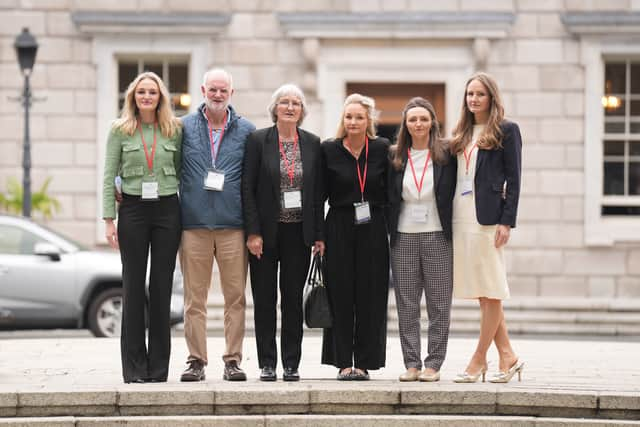
However, the Department of Justice later said this week that gardaí will retain responsibility for the conduct of prosecutions in court under a reform model currently being pursued – despite the Commissioner’s comments.
The department said such a change would not be “appropriate”, instead insisting its reform model would capture the “intent” of the 2018 Commission on the Future of Policing’s recommendation.
It said the work of a steering committee on the proposal, which would also support the Director of Public Prosecutions (DPP) in “enhancing quality assurance” of garda prosecution functions, is ongoing.
A member of the O’Farrell family noted the Commissioner was not aligned with the department on the matter, and added that capturing the “intent” of the recommendation was not the same as implementing it.
The family raised a number of questions about whether any recommendations of the Staines review into bail had been implemented, who conducted the review into garda prosecution functions, whether it had considered the input of families who contributed to the Staines review, and why it reached its conclusion.

The family member told the Press Association: “The department has also said that the recommendation was ‘accepted in principle’ subject to evaluation of its ‘implications and resource demands’.
“We therefore ask directly: Was this decision driven by cost?
“If so, the Government should say so openly, and explain how it weighs that cost against the cost to people’s lives of a bail system that the (Staines) Report described as cumbersome, inefficient, inconsistent and haphazard.”
She further said that describing the reform model as capturing the intent of a recommendation “is not implementing the recommendation”
“Enhanced quality assurance by the DPP of prosecutions conducted by An Garda Síochána is not the same as prosecutions being conducted by independent legal professionals.”
She called on Minister Jim O’Callaghan to publish the review and the group’s recommendations, as well as the membership of the steering committee.
“Where the Government departs from a recommendation, it should say so openly and explain why.”
The family also want progress on the report’s other recommendations around the power of arrest without warrant for reasonably suspected breach of bail conditions, and immediate investment in information-sharing between the Courts Service, An Garda Síochána and other police forces.
They said “these are failings that cost Shane his life”.

On August 2 2011, Mr O’Farrell, a 23-year-old law graduate, was cycling home when he was hit by a car in the Carrickmacross area of Co Monaghan.
The driver of the car, Zigimantas Gridziuska, failed to stop.
The Lithuanian national had a number of previous convictions, including for theft and drugs offences.
On the day he hit Mr O’Farrell, Gridziuska should have been in jail for breaches of bail conditions that were applied to him at the time.
Gridziuska was prosecuted in February 2013 for dangerous driving causing Mr O’Farrell’s death.
He was acquitted of that charge by direction of the trial judge and, under the law at the time, a lesser charge of careless driving was not open to the jury.
It is understood he has returned to Lithuania.
Mr O’Farrell’s family have been calling for a public inquiry into the circumstances of his death and why Gridziuska had not been in jail.
The Department of Justice has been contacted for comment.