
National: Revealed: How many pints of Guinness could your weekly wage get you each year since 1997?
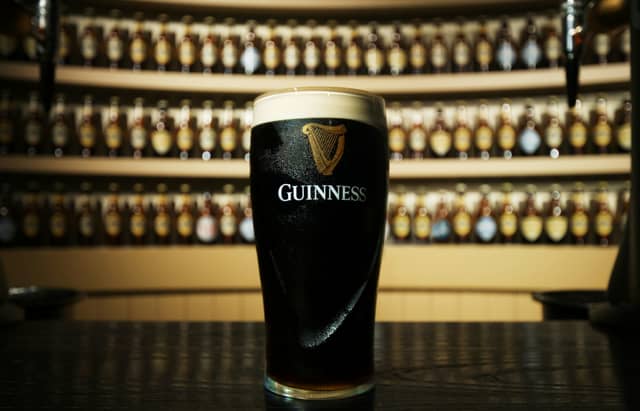

Pints of 'The Black Stuff' have risen considerably over the years
As St. Patrick’s Day approaches, revellers the world over will be flocking to their local pub or bar come the 17th for a pint (or three) of ‘the Black stuff’.
And while you’ve likely already heard of the ‘Guinness Index,’ Irish savings marketplace Raisin Bank has taken it one step further by calculating exactly how many pints of Guinness (or equivalent-brand Stout) you could buy using your entire weekly salary (no judgement) – and how that number has fluctuated over the last 27 years.
Findings:
Since its inception in 1759, Guinness has long been considered a cultural icon in Ireland.
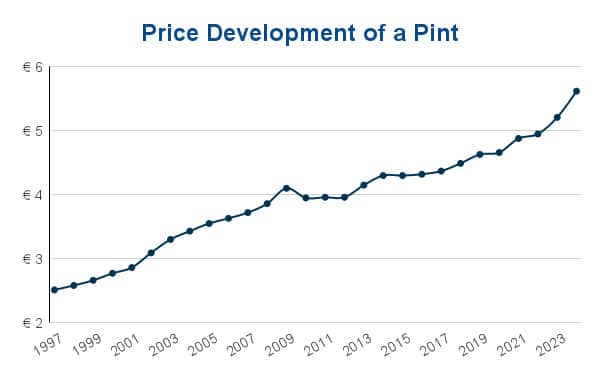
In recent years, its fluctuating price has been seen as representative of broader economic trends in the country. Indeed, pub-goers will remember all too well when a pint of stout surpassed €3 (in 2002) €4 (in 2013), and, ten years later, €5 (and rising!).
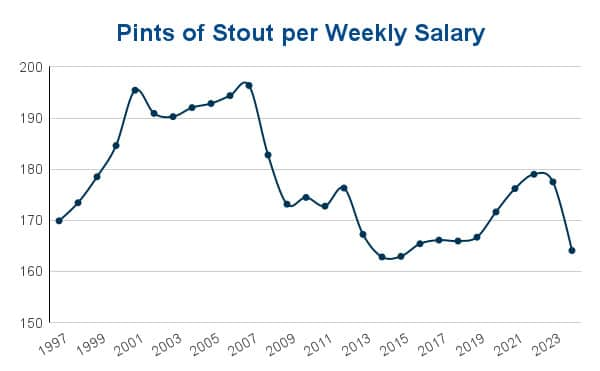
Taking into account the average weekly salary in Ireland and the average cost of a pint of Guinness (or equivalent-brand Stout), back in 1997, you’d get 170 pints with your €427 pay cheque.
However, we all know what came next.
Following the 2008 financial crash, it would take another decade for the average weekly pay cheque in Ireland to exceed where it was in 2007 – and when it did (with a weekly average wage of €744, in 2018), pub-goers could now only get 165 pints for their money.
In fact, in 2024, although the average weekly salary is now more than double what it was in 1997 (€922 vs €427), you’d now get six fewer pints (164 vs 170) with your paycheque than you would 27 years ago.
Our ‘stout vs weekly salary’ index shows, therefore, that the best years for Guinness fans were 2007 (195 pints / €730), 2001 (195 pints / €559), and 2006 (194 pints / €706), and the worst were 2014 (163 pints / €700), 2015 (163 pints / €701) and 2024 (164 pints / €922).