
‘We don’t want to be here’, say ‘fed up’ striking ambulance workers
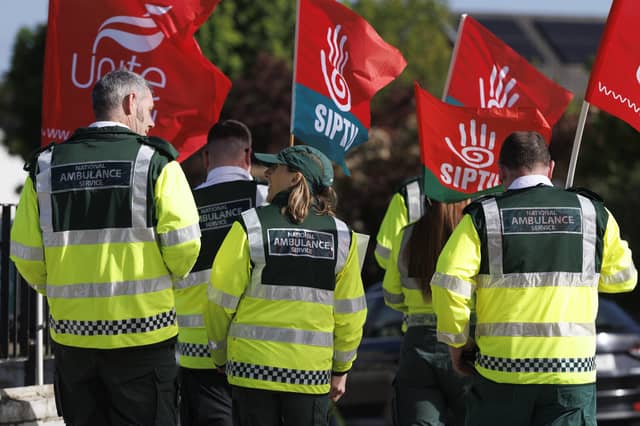

A steady stream of honks and beeps greeted the picket line outside the National Ambulance Service Dublin South Central depot on Tuesday morning.
About two dozen uniformed ambulance workers moved in slow and steady circles carrying Siptu placards and flags.
Among them, a handful of journalists and paramedics jokingly squabbled with each other about who would give an interview.
Confident and decisive when dealing with some of the most horrific situations imaginable, including the aftermath of car crashes and brutal attacks, speaking with the media is out of their comfort zone.
“We don’t want to be here” is the frequently repeated refrain.
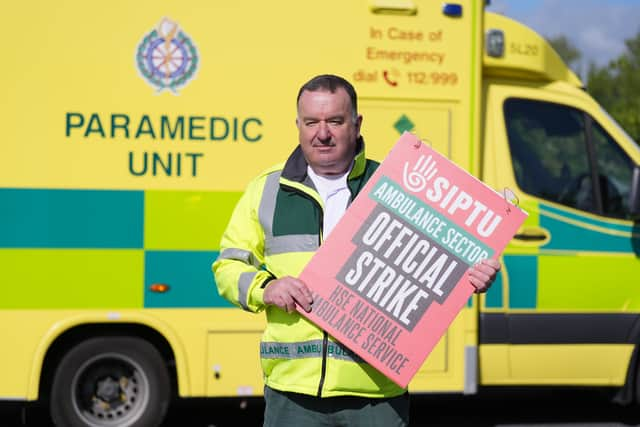
She said they are “fed up” and are “standing our ground”.
More industrial action is scheduled for later in May and June and her colleagues are “absolutely” in it for the long haul, Ms Lawless said.
She is one of around 2,000 emergency medical technicians (EMT), paramedics, advanced paramedics, paramedic specialists and paramedic supervisors from the Siptu and Unite unions at the National Ambulance Service involved in the work stoppage
They say their jobs, and the qualifications they need, have changed significantly in the last 15 to 20 years, but pay has not been adjusted to reflect that.
Domhnaill Joyce at the picket on Davitt Road, said: “Originally, we were effectively a transport service where we just went out, picked up a patient, put them on a stretcher, and brought them in.
“We now have advanced practitioners, we have people in helicopters, we have people on motorbikes, doing rapid response and providing advanced life support at the side of the road.
“We can now provide the exact same level of care that’s given in a resus (resuscitation) room on the scene at the time, obviously, greatly increasing the patient’s risk of survival.
“People that wouldn’t have made it to hospital 20 years ago are now making it to hospital.”
The EMT and Siptu shop steward points in the direction of the long-delayed National Children’s Hospital Ireland (NCHI), which is less than two kilometres from the ambulance station.
“The HSE are willing to put money into all kinds of projects,” he says.
“Even into replacement of our vehicles, the equipment, the drugs, all that kind of stuff.
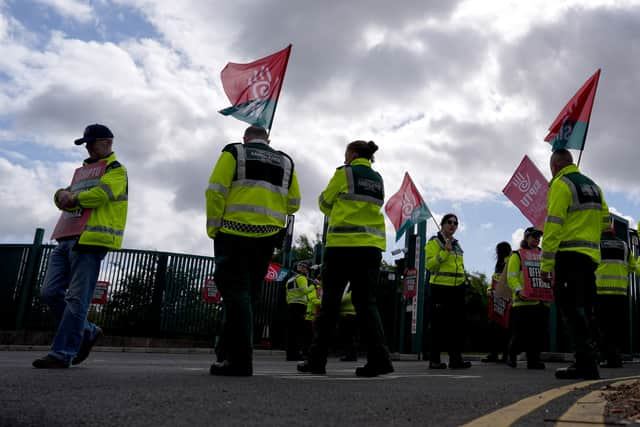
In Co Louth, the mood was similarly upbeat; passers-by dropped off snacks and bottles of water to the striking workers.
As part of contingency plans, they are ready to go back to work at a moment’s notice and union leaders say if a major emergency happens, “that’s everyone off the picket lines”.
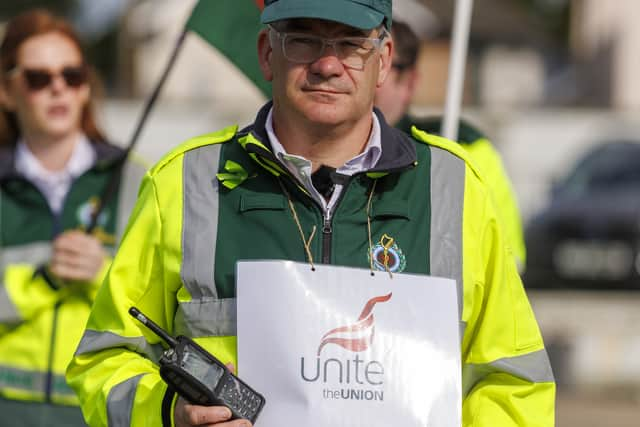
Tony Murphy, who is based at Dundalk Hospital, pulled out a two-way radio: “If this radio goes off, we will leave the picket line, I will go and do a call.”
He has been a paramedic for 26 years and “loves” his job.
“It’s a job where you’re helping people and making a change, dealing with the public in their time of need.”
“It’s an excellent career, I’ve loved every minute of it, but unfortunately, today this is a low point, being forced to the gate,” he added.
Niamh Quigley joined a voluntary ambulance service when she was 14 and comes from a health worker family: “So I was going to go down the health service route one way or another.”
She said as a paramedic, “you get to see all walks of life” and “you’re there for the happiest days and saddest days of people’s lives, and everything in between”.
Ms Quigley said not only is the role evolving, but the demands of the public are also changing.
“Since covid, a lot of people are more scared about going into hospital, so they’re kind of leaving it longer and longer, and they’re getting sicker and sicker before we bring them in.
“Or we’re getting people who don’t know when it’s appropriate to ring an ambulance, we’re getting calls for paper cuts.
“I had a call last year for an 18-year-old who was stung by a bee who wasn’t allergic to bee stings.”
In a statement, the Department of Health said it is “regrettable” that the strike had proceeded, adding that industrial action would have a significant impact on service capacity and a risk of disruption to emergency care and timely access to lifesaving services.
It said: “The State accepts that NAS pay structures need to be modernised and previous engagement at the Workplace Relations Commission (WRC) concluded with the State offering pay increases of 3-14%, on top of the 9.25% increase under the current public service agreement.
“These increases were linked to essential service reforms designed to improve patient care, response times and how services are delivered, by supporting better deployment and training and professional development of staff.”
The department said the only way to resolve the issue is “through dialogue” as it urged unions to re‑engage with HSE management.
Government figures have urged the union representatives to re-engage with State industrial relation mechanisms.
Taoiseach Micheal Martin said: “It is not satisfactory for patients or the people generally that a first-responder service should be mired in industrial action of this kind.”
He urged unions to re-engage in dialogue, adding: “It is the only way this will get resolved.”