
Smart sensor from Donegal helps protect clean water in Uganda


Technology developed in Donegal is helping to provide clean drinking water in Uganda and could be rolled out to other countries next year.
Since 2019, researchers at the Atlantic Technological University (ATU) in Letterkenny have been working on a smart sensor to detect faults in the handpumps being used in boreholes in rural Uganda.
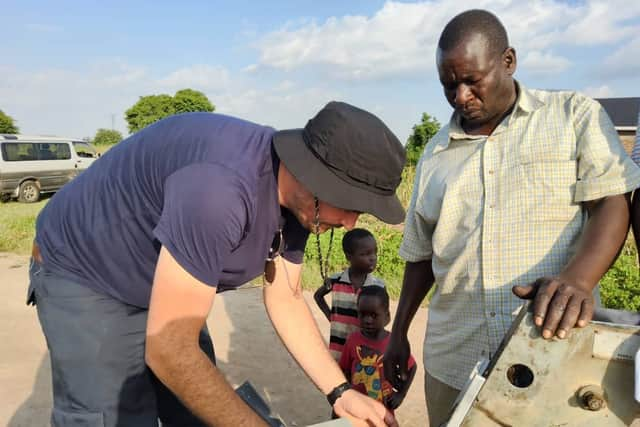
Many communities in rural areas rely on handpumps to retrieve clean water from boreholes. If these pumps fail, they have to resort to drinking water from surface wells which can be contaminated with high levels of e-coli.
Authorities often struggle to adequately monitor all the boreholes in their areas.
In September, research engineer Sennan Morris travelled out to Kumi region in the east of Uganda to install the latest prototype of the technology in 10 boreholes.
The small solar-powered device monitors the water volume, number of strokes on the pump handle and its lateral movement.
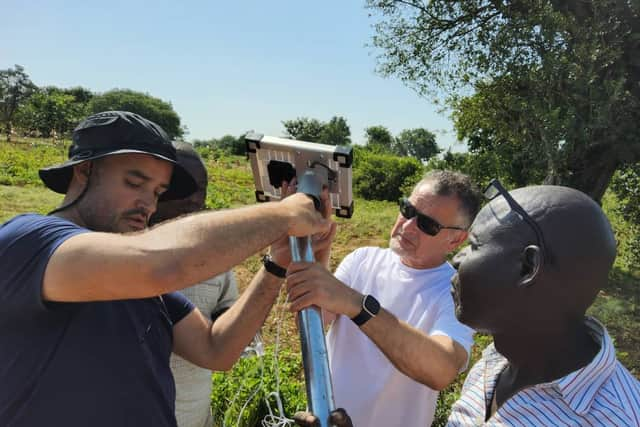
The instrument sends information via the Ugandan cell network to the cloud, where it is accessed by the team in Donegal.
If there are any issues they text a local mechanic who can go and inspect the pump.
Mr Morris acknowledges the trans-continental nature of the alert system “sounds a bit funny”, but they hope to “hand over” to their charity partner Fields of Life next year.
Researchers have already been approached about potentially installing the devices in pumps in Liberia, and he said they could be adapted for use anywhere people use boreholes to access water.
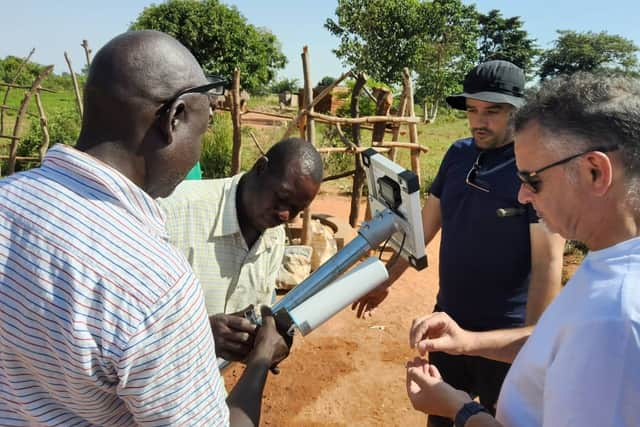
The project is based at ATU’s Wireless Sensor and Applied Research (WiSER) lab and started after a trip to Uganda by board member Ray Speer, where he became aware of the issues with borehole pumps.
The project is a partnership between the lab and a number of partners including consultancy firm Arup, semiconductor company Analog Devices, and the Kumi District Water Office and is also supported by Enterprise Ireland.
The WiSER lab specialises in developing technology using The Internet of Things.
The Internet of Things refers to systems which connect everyday objects to the cloud so that data can be collected and shared, like how smart watches can monitor footsteps and send that information to a phone.
Other projects being developed at ATU’s WiSER lab have applications closer to home including one which is monitoring the impact of sea water on a golf club in Belmullet and a system to monitor the tanks in an aquarium on Achill Island, both in County Mayo.