
No ‘one figure’ on united Ireland, Tánaiste says
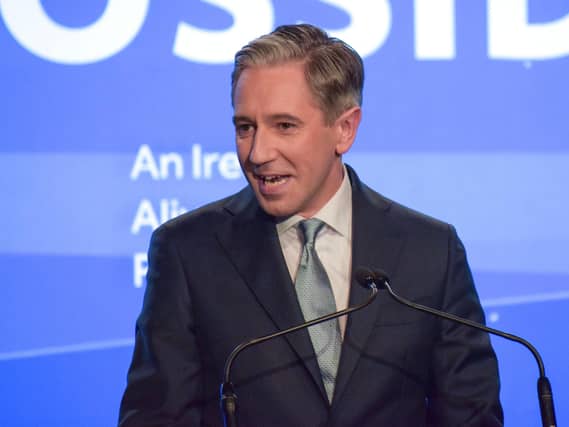
Opposition parties had piled on pressure for the Government to make preparations for a debate on a united Ireland.
There is no “one figure” for the cost of a united Ireland, the Tánaiste said, as he said his party’s policies provided for more “sophisticated” discussion on the proposal.
At the Fine Gael Ard Fheis in Cork on Saturday, the party published a “blueprint” on Irish unity which proposed a new junior minister for North-South relations in a dedicated unit within the Department of An Taoiseach and the establishment of a dedicated sovereign wealth fund to deal with the potential costs of transition.
The publication of the report came shortly after Taoiseach and Fianna Fáil lead Micheál Martin suggested a body, the Future Studies Initiative, should be appointed to oversee research into future scenarios for Irish unification.
Opposition parties had also piled on pressure for the Government to make preparations for a debate on a united Ireland.
The blueprint projected a potential worst-case cost of a united Ireland could be up to 25 billion euro in year one.
The most adverse high-cost scenario also estimates a potential bill of 41.2 billion euro for year 25 after unity.
The cost to the Exchequer in year one ranges from circa 3.2-25 billion euro depending on the design and the deal with the British Government, according to the report.
The settlement with the British Government on pensions and debt is the largest policy choice in the early years, the report states, from between four billion euro and 24.8 billion euro.
On Sunday, Fine Gael leader Simon Harris said he wanted to see a united Ireland in his lifetime, adding that gathering a sustainable majority for the constitutional change would require political leadership being able to answer questions raised by the blueprint.
Asked if he believed Fine Gael voters would be happy to pay 25 billion euro in the first year of a united Ireland, Mr Harris said: “I don’t think anybody on the island of Ireland would see 25 billion euro as – let’s call it – a settlement amount in relation to a unified island in the first year, and that’s not the purpose of the document today.”
He added: “What we’re basically saying is if you decided on day one – which isn’t how anybody would unify anything, by the way – but if you decided on day one everything would be immediately aligned and there would be, let’s call it, a bad settlement with Britain.
“In other words, Britain wouldn’t play play any role around debt or pensions, the cost could be up to 25 (billion).
“If you did this over a more sustained period and there was – let’s say – a better arrangement with the UK in the first instance, the cost could fall to three.”
Mr Harris said the question on the single-figure cost of a united Ireland is “unfair” as “it doesn’t exist”.
“That’s why the conversation does require a proper standalone constitutional forum, ongoing engagement, and a conversation that’s maybe more mature and sophisticated.”
The publication of the document was welcomed by Sinn Féin leader Mary Lou McDonald and SDLP leader Claire Hanna.
However, the DUP dismissed the blueprint as part of a political “race in Dublin to look the greenest” and said it had “nothing to do with the people of Northern Ireland”.
Gareth Wilson, DUP MLA for Newry and Armagh MLA, said: “Northern Ireland’s place in the United Kingdom rests on the consent of the people who live here. Fine Gael signed up to that principle.
“No forum, no secretariat and no five-year talking shop in Dublin changes it.”
Mr Wilson said the Irish Government needed to deal with legacy issues around “terrorists who used the border as a shield” before “planning a fantasy future”.
“If the Irish Republic wants good relations with its neighbours, there is plenty of real work to do.
“Unionists will engage on that as good neighbours always have.
“What we won’t do is take part in a process designed to dismantle the Union we’re proud to belong to.”
Deputy leader Helen McEntee previously said the party would have discussions on running candidates in Northern Ireland when asked if it was fair for Fine Gael to use its subtitle “The United Ireland Party”.
Asked for an update on those discussions on Sunday, she said there were “no plans” to run candidates in Northern Ireland’s upcoming elections but added: “At the same time, if that was a decision that we were to take, it would be taken within the party.
“Our focus has been on this particular document, and I think what it shows is, for the first time, certainly since I’ve been involved in politics, is that we are having real conversations around what a unified Ireland might look like.”
Minister Neale Richmond said the issue of running candidates in Northern Ireland did come up during regional engagements in preparation for the blueprint.
He said membership was “realistic” that it would involve a process including “reasserting” Young Fine Gael branches in universities.