
How adding four seeds to your diet can help regulate your hormones
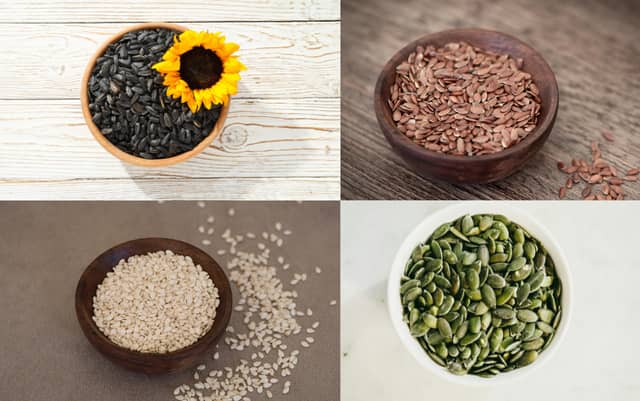

Seed cycling is a process that involves eating certain seeds at different stages of your menstrual cycle and is said to help regulate hormones
Seed cycling is an alternative form of medicine that is said to regulate hormones, specifically women's reproductive hormones.
It is not a scientifically backed practice but there is anecdotal evidence to suggest it has benefits.
Seed cycling involves eating four different seeds at different stages of your menstrual cycle to help regulate symptoms and hormones.
The four seeds are pumpkin, flax, sesame, and sunflower.
You eat a teaspoon of two types of ground seeds daily for roughly two weeks at a time and then switch to the other two seeds.
Whole seeds don't fully break down in your gut, so grinding them allows your body to extract more nutrients, vitamins, and fatty acids from them.
It is these seed components that are said to support healthy hormonal functioning.
Seed cycling is also believed to help regulate menstrual cycles, reduce PMS symptoms, boost fertility, and ease menopausal symptoms.
The seeds can be eaten alone or added to other foods like smoothies and salads.
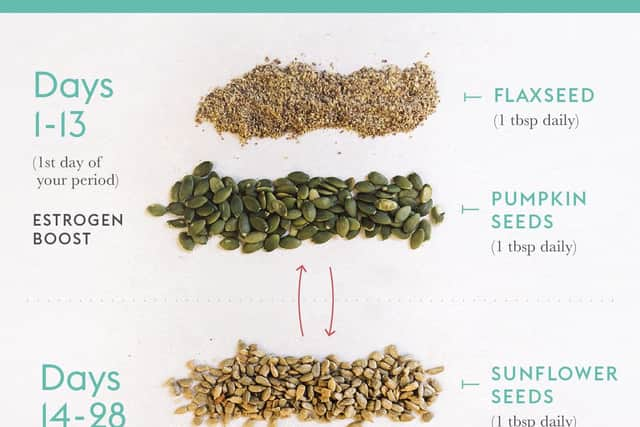
Phase one involves eating one tablespoon of raw, ground pumpkin seeds and one tablespoon of raw, ground flax seeds.
You start this on day one of your period until the day before you ovulate.
Pumpkin and flax seeds are believed to support the estrogen-dominant follicular phase of your cycle.
Phase two involves eating one tablespoon of raw, ground sunflower seeds and one tablespoon of raw, ground sesame seeds.
You do this from the day of ovulation until the day before the first day of your period.
There is little research to suggest seed cycling is effective, but there are some small, limited studies.
A 2023 study of 90 people with PCOS found that seed cycling helped improve the hormonal imbalance which is a characteristic of the condition.
Older research shows that flaxseeds help in lengthening the luteal phase of the cycle.
This may improve ovulation and reduce common premenstrual symptoms, such as breast pain and cramping, according to a blog on Parsley Health's website.
Generally, it takes about three or four months before you notice a difference from seed-cycling, if any at all.
Laura Hampson is a freelance journalist who tried it for a month and wrote about her experience in Glamour.
She was originally drawn to the idea of seed cycling because it alleged to reducing period pains and cramps.
After a month of trying it out, Laura shared her verdict.
"While my period was still heavy and there were pains, these were less noticeable than before and I found myself having to take painkillers less than I normally would," she wrote.
Previously, she had really suffered with menstrual pains.
"My cycle has been consistent for as long as I can remember, arriving each month bang on time, with a heavy first two days bringing pains often so bad that I need to lie down for a good 10-20 minutes when they hit," she said.
Whether seed cycling is proven scientifically or not, it seems it can work for some people and there appears to be no health risks involved in giving it a go.