
European spacecraft launches to explore whether moons of Jupiter can support life
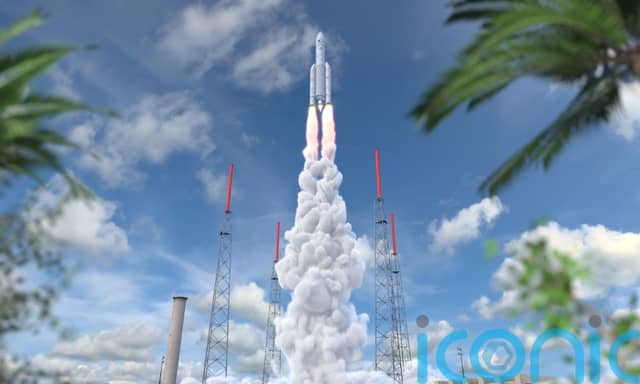

A European spacecraft has launched and is on its first leg of the journey to Jupiter in a mission to explore whether its ocean-bearing moons can support life.
The six-tonne probe, named Juice (Jupiter Icy Moons Explorer), blasted off on an Ariane 5 rocket on Friday at 1.14pm UK time from the European spaceport in Kourou, French Guiana.
Juice was due to take off on Thursday but weather conditions showed there was a risk of lightning, temporarily pausing what would have been the agency’s first attempt to send spacecraft to orbit another planet’s moon.
It will need to separate from the rocket before beginning a 4.1 billion-mile journey which will take more than eight years.
Scientists from Imperial College London have led the development of one instrument, known as the magnetometer.
Called J-MAG, it will measure the characteristics of magnetic fields of Jupiter and Ganymede – the only moon known to produce its own magnetic field.
Juice will perform a manoeuvre known as gravitational assist, where it will use the gravity of Earth and Venus to slingshot toward Jupiter.
At its destination, the spacecraft will spend at least three years making detailed studies of Jupiter, Ganymede, Europa and Callisto.
Juice is not equipped to search for signs of life but its aim is to explore the conditions that could support life.
Beneath the ice crust of Europa is thought to lie a huge ocean of liquid water, containing twice as much water as Earth’s oceans combined.
But scientists are more interested in Ganymede, Jupiter’s largest moon, which is thought to have a salty ocean beneath its icy shell.
One of Juice’s key goals is to explore this body of water and determine whether this world may be habitable.
Data gathered from the J-MAG instrument will help characterise the depth and salt content of Ganymede’s ocean.
Juice has been built to withstand harsh radiation and extreme conditions, ranging from 250C around Venus to minus 230C near Jupiter.
Sensitive electronics are protected inside a pair of lead-lined vaults within the body of the spacecraft.
If all goes well, Juice should reach Jupiter in July 2031 and will have enough fuel to make 35 flybys of the icy moons before orbiting Ganymede from December 2034.
Once the spacecraft runs out of fuel, Juice will perform a controlled crash into Ganymede, marking the end of the £14 billion mission.