
Earth's inner core may be changing rotation, new research suggests

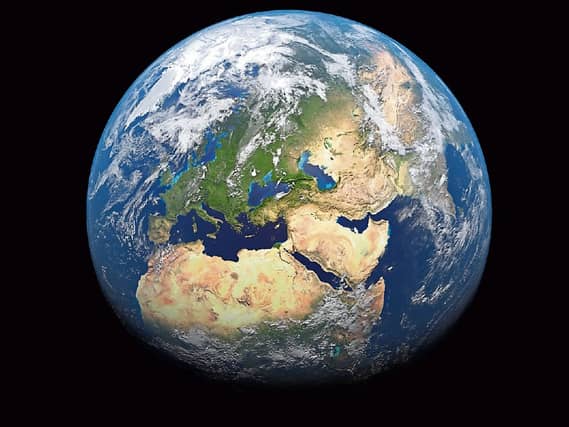

Scientists have reason to believe that our planet's inner core may be changing rotation.
According to new research published in journal Nature Geoscience, which analysed seismic waves from repeating earthquakes over the last six decades, the core seems to have slowed in recent years.
Not only that, but at one point, it may have 'paused' in 2009... and then switched its rotation.
The study's authors, Xiaodong Song and Yi Yang of China's Peking University, said they found that the inner core's rotation 'came to near halt around 2009 and then turned in an opposite direction.'
The pair now believe that the core may be in a cycle of oscillation, where it spins in one direction, stops, and then spins in the opposite direction.
"One cycle of the swing is about seven decades, meaning it changes direction roughly every 35 years," they told the publication AFP.
Song also told another publication (Inverse): "If the oscillation model is correct, we expect that the inner core will keep rotating slower than the surface until the mid-2040s."
They further said that they believe there are physical links between all Earth's layers, from the inner core to the surface.
Earth's inner core, is around the size of the dwarf planet Pluto.
It is roughly 5,000 kilometres below the surface we live on: it can spin independently because it floats in the liquid metal outer core.